Beuys studied sculpture at the Dusseldorf Academy of Fine Arts. By the time he graduated as a master student, Beuys work consisted mainly drawings that used unconventional materials and were often difficult to interpret. In 1961, Beuys became a professor of 'monumental sculpture.' It was during his time teaching that he became internationally known. Beuys was doing a performance art at an anniversary of an assassination attempt on Hitler when students attacked the artist. Beuys continued teaching (even after being dismissed from the University), being a shaman to his students and even participated in politics the rest of his life.
Sunday, November 25, 2012
Joseph Beuys
Beuys studied sculpture at the Dusseldorf Academy of Fine Arts. By the time he graduated as a master student, Beuys work consisted mainly drawings that used unconventional materials and were often difficult to interpret. In 1961, Beuys became a professor of 'monumental sculpture.' It was during his time teaching that he became internationally known. Beuys was doing a performance art at an anniversary of an assassination attempt on Hitler when students attacked the artist. Beuys continued teaching (even after being dismissed from the University), being a shaman to his students and even participated in politics the rest of his life.

Monday, November 12, 2012
Brion Gysin
Brion Gysin was an important painter, writer, and performance artist of the twentieth century. Gysin studied surrealism with the greats at a very young age. But when he was about to preview some of his work, he was expelled from the surrealist group by Andre Breton. After serving in World War II, Gysin opened a restaurant in Morocco called 1001 Nights. But four years later he would again face failure when his restaurant was closed. Moving back to Paris, Gysin moved into the Beat Hotel and discovered a Dada technique by accident. Slicing through a pile of newspapers, Gysin translated a painting technique into writing by mixing together raw words and text. Gysin's close friend William Burroughs used this cut up technique in several of his novels.
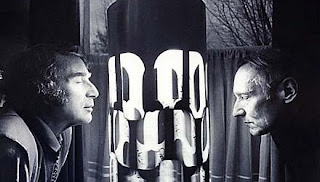
Another invention of Gysin is the Dreamachine. The dreamachine is made from a cylinder with slits cut on the side and then is placed on a rotatable object which turns the entire contraption. There is a light source in the center of the piece. With the combination of the light and the revolution, the dreamachine pulsates and gives the viewer a feeling of relaxation. The dreamachine is experienced with eyes closed. The effect of the dreamachine can be very intense and can cause the viewer to enter a hypnagogic state.
Another invention of Gysin is the Dreamachine. The dreamachine is made from a cylinder with slits cut on the side and then is placed on a rotatable object which turns the entire contraption. There is a light source in the center of the piece. With the combination of the light and the revolution, the dreamachine pulsates and gives the viewer a feeling of relaxation. The dreamachine is experienced with eyes closed. The effect of the dreamachine can be very intense and can cause the viewer to enter a hypnagogic state.

Tuesday, October 30, 2012
Grid Art

Here is my piece of grid art. It is an embroidery that took 25 hours, 23,000 stitches and a lot of yards of string. Although it took me much longer than expected, I am happy with the results. This is the original image that inspired me.

Dada Manifesto

Dada was an art movement in response to World War I that begun in Zurich, Switzerland in 1916. Dada was anti-bourgeous in addition to anti-war and was the beginning of the abstract art movements in the 1900s.
Dada was an informal movement, but at it's roots believed that the bourgeous attitude of Europe was what brought on the war. According to Hans Richter, dada was anti-art . Dada represented everything art was not. Dadaists hoped to destroy culture and aesthetics.
Some of the techniques that were developed through the dada movement are collage, photomontage, assemblage, and readymades.
While art historians look on dadaism with criticism, there is no doubt that this movement contributed a lot to the art of the 20th century and beyond
Here's a short video I found on the history of dada
Violence in Video Games
This video explains the way that I feel about video games and their potential affect on future violence in children. Violent and action video games have been around for almost 20 years now. So if these games directly cause the player to become a sociopath and a killer, wouldn't we half of the nation be killing other people?
Media in general has desensitized the general population to violence and death, but desensitization is not enough to make people start being violent. Humans in their nature are constantly at a war with themselves. We have a strong desire to create and build, but at the same time, we are very destructive in nature. To say that we are more violent now than we ever have been just doesn't make any sense. The only reason why our destruction may seem greater is because we have created more advanced weapons to do the destruction for us.
While I don't think that 8-year-old kids should be playing a bunch of shootem-up games, I think that it is the parents responsibility to educate their kids about the differences in fantasy and reality.
Ray Kurzweil and Futurism
Ray Kurzweil has a long list of titles that goes along with his name. But the one that he is most known for is being a futurist. But what is a futurist? Futurologists are scientists that attempt to systematically predict the future. So what is it that a futurist does? I imagine this guy sitting in a dark room pondering with a pipe and pulling random ideas out of a hat. Well I guess a futurist does a lot more than that.
Futurists consult with different companies and public organizations about upcoming global trends, plausible scenarios, emerging marketing opportunities, and risk management. Futurists are basically practicing probability.

Ray Kurzweil is most known as his position as a futurist, but he also has done a lot of studies in transhumanism. This new trend in futurism looks into the ways that humans will extend their intelligence through the use of technology.
Kurzweil has written many books on the future of humanity and some of his predictions have come true. In the 1980's he published a book called "The Age of Intelligent Machines" in which he predicted that by the end of the 1990's most of our documents would exist solely on computers and the internet.
While Kurzweil has received criticism for some of his ideas, I believe that humans really are curious about the future of humanity and love looking to smart people such as Kurzweil for answers.
Futurists consult with different companies and public organizations about upcoming global trends, plausible scenarios, emerging marketing opportunities, and risk management. Futurists are basically practicing probability.
Ray Kurzweil is most known as his position as a futurist, but he also has done a lot of studies in transhumanism. This new trend in futurism looks into the ways that humans will extend their intelligence through the use of technology.
Kurzweil has written many books on the future of humanity and some of his predictions have come true. In the 1980's he published a book called "The Age of Intelligent Machines" in which he predicted that by the end of the 1990's most of our documents would exist solely on computers and the internet.
While Kurzweil has received criticism for some of his ideas, I believe that humans really are curious about the future of humanity and love looking to smart people such as Kurzweil for answers.
War of the Worlds
When War of the Worlds first aired on October 30, 1938, panic ensued in much of North America and parts of Canada. Looking back, it seems silly to us that people would believe that aliens were actually invading. The circumstances that lead radio listeners to believe that the world was coming to an end was a part of a perfect storm of state of mind, format, and and a more trustworthy view of the medium.
When War of the Worlds aired, the general public were in a state of heightened security awareness from the climate of the world scene. The second world war was causing tension and panic world wide already. America was also coming out of the great depression which was a time where the radio became a staple in every American household. The radio had become a source of entertainment and a way to get information about what was happening in the world.
Every radio program had a certain format that the public had grown accustomed to. So when Orson Welles wrote War of the Worlds in a news format, people believed it. I've heard people today shake their heads and say that the only reason why people panicked with War of the Worlds was because people used to be much more naive than we are today. I just don't think that's true. Instead, I think that people today are just more cynical towards media. We are used to having information instantly and know that many times this information could be false or exaggerated. But even though we know that the information may be assumed, the majority of the public still believes what we are told anyways.
So maybe we are naive too.

When War of the Worlds aired, the general public were in a state of heightened security awareness from the climate of the world scene. The second world war was causing tension and panic world wide already. America was also coming out of the great depression which was a time where the radio became a staple in every American household. The radio had become a source of entertainment and a way to get information about what was happening in the world.
Every radio program had a certain format that the public had grown accustomed to. So when Orson Welles wrote War of the Worlds in a news format, people believed it. I've heard people today shake their heads and say that the only reason why people panicked with War of the Worlds was because people used to be much more naive than we are today. I just don't think that's true. Instead, I think that people today are just more cynical towards media. We are used to having information instantly and know that many times this information could be false or exaggerated. But even though we know that the information may be assumed, the majority of the public still believes what we are told anyways.
So maybe we are naive too.

Subscribe to:
Posts (Atom)